



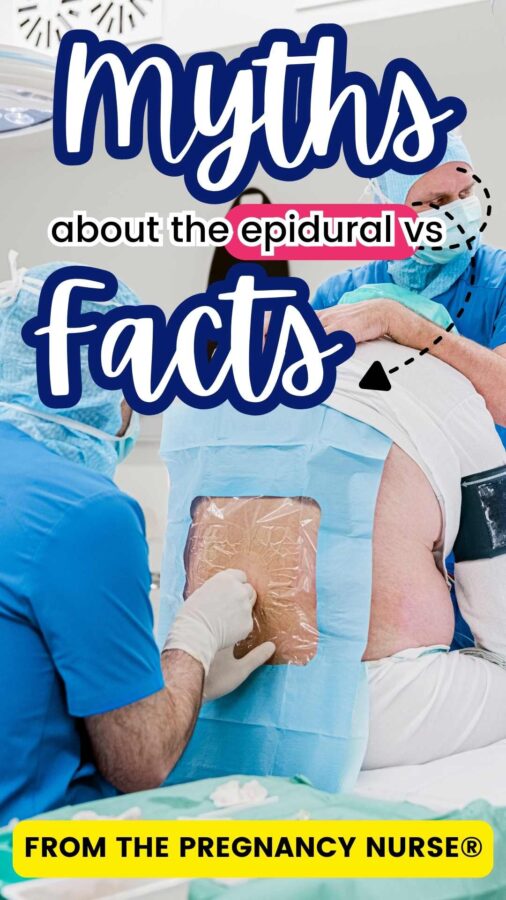
Epidurals have always been a mine field of opinions, but today I want to share some of the myths vs facts about the epidural, and how I feel social media isn’t doing us any favors about this tricky topic.
This is part of my Complete Guide to Epidurals — so if you have more questions don’t miss that!
I also have a video on this topic:
Before we jump into this I see a lot of people who have literally no business speaking about epidurals online. Most often this is chiropractors who really love to scare patients and feel like it’s their place since it is placed in your back. Please take your advice from an expert in the field — someone who places epidurals, or sees LOTS of laboring patients (that’s me!), or manages their postpartum medical care. Please don’t take it from someone who uses scare tactics to build their social media following (and often sell you something). I’m not here for that. I hope you’re not either.
Ok, let’s get going on the myths!
You Have (Get) to Decide Today
I feel like people on social media want you to decide the minute you get that positive pregnancy test if you want an epidural that day. The reality is you should:
- Learn about the epidural
- Get some natural pain management tools & techniques (don’t worry, talking about that more)
- Be open to what happens as you’re in labor
Remember labor comes in all lengths, and pain levels.
Some people have excruciating labor from the first contraction on, and some people manage it pretty easily until they’re into active labor.
That doesn’t mean that one is weak and one is “strong” — it’s just different — how baby is positioned, the nerves they have in that area and how much sleep they’re able to get.
I’m a huge fan of deciding based on the facts when labor happens.
But I am ALSO a big fan of thinking through what you’d like, and any preferences you have (like scared of needles, or not being “tied” to the bed)….
That’s why I have a birth plan mini series that’s totally free for you right here:

I actually have a whole post on what to do if you can’t decide if you want an epidural that will give you more on that topic. And remember, all of this is after seeing patients from all cultures, and walks of life for 20 years in the labor room. Plus three kids of my own. I get this.
Long-Term Back Pain With It
Ok, this is the biggest one “I had back pain” after the epidural.
Here’s the truth:
1 — You will likely have some back pain at the site of insertion for the first few weeks after birth.
This would be normal any time we puncture the skin with a needle and bug the surrounding area as we place it. You’ll also have this type of pain where your IV placement is. However, studies show…
2 — Those who get the epidural don’t have rates of long-term back pain higher than those who didn’t.
People come back and say it’s “right at the spot where they placed the epidural” but the reality is that particular area gets the worst of our expanding bellys and our bodies trying to stay upright for MONTHS of pregnancy.
Our backs take a huge burden during pregnancy, labor, birth and life with baby (looking at you giant car seat). They need some TLC after baby is born.
- Make sure that you’re using good posture and lifting techniques with breastfeeding, baby gear and baby tasks.
- Use mild stretching once you feel up to it postpartum, and work into a good core program after baby is born
- Possibly using physical therapy to help (I wish a physical therapy appointment postpartum was a standard of care and I won’t rest until it is).
I never did well at this — and I’m working my way through the Mommy Tummy Fix right now. When you’re ready — Join with the FREE 7-day trial. See what you think, the cancel and join the lifetime option and use code NURSE30 to get $30 off the lifetime access (bringing it to $119). It’s never too late to help our backs my friends! (this is a partner link)
Yes, with any procedure there is a chance of having some irritation to the areas surrounding it, but when done correctly the epidural doesn’t cause long-term back pain.
That baby did, and you just need to take care of yourself to rehab it “back”. I hate this, but it’s true. For many of us, this is a life-long persuit.
Want to know more about epidurals? — check out these posts:
- Why People Get An Epidural Even When They’re Not Planning On It
- Do You Need a Birth Class if You Plan to Get an Epidural
- 3 Tips to Using Movement During Labor WITH an Epidural
- Epidurals During Pregnancy & Labor
- How Many CM Do You Need to Be to Get An Epidural?
Slows Down Labor
People say the epidural will slow down your labor — but studies don’t bear that out.
This Cochrane review showed that it may increase it by about 15 minutes. It did show an increased instrumental delivery (but that may be for a variety of reasons including that people with a mal-positioned baby are more likely to get an epidural) but not that it prolonged labor.
Source: Anim‐Somuah M, Smyth RMD, Jones L. Epidural versus non‐epidural or no analgesia in labour. Cochrane Database of Systematic Reviews 2011, Issue 12. Art. No.: CD000331. DOI: 10.1002/14651858.CD000331.pub3. Accessed 19 January 2026.
Honestly, in some case that I have seen, it does seem to “slow” it a bit — in my mind I’ve always thought it was because of the increased amount of fluids we gave prior to giving it. You’ve got to think that “dilutes” the amount of oxytocin in your blood stream — but once that’s taken care of labor most often chugs along nicely. And in some cases, we end-up start Pitocin to make it keep going. I think that’s a risk you do take with the epidural.
AND in some cases I think it speeds it up by quite a bit. Patients are finally able to relax, which allows baby to descend (sometimes quickly) into the birth canal.
So, “overall” statements about this doesn’t help anyone. We have to take it on a case by case basis, and know that we’re not quite sure what our body will do with the epidural.

Increased Cesarean Rate
I hear this all the time and honestly — like I said before this may be true because:
- People who are being induced early tend to get an epidural due to the length of labor
- Early inductions come with a medical reason which may increase their need for a cesarean overall
However, that same Chochrane review didn’t show an increased cesarean rate. I would guess that they may have eliminated people who had risk factors for a cesarean before showing the epidural alone didn’t increase your risk.
This one did show some correlation in increased cesarean rate if you get it before active labor, or 4 cm. It showed it increases malposition — which is why movement in labor is so important. Honestly, I’m also a fan of waiting until you’re at least 4 cm to get it — which is why everyone needs some natural pain management techniques — more on that coming (but I recommend this).
These studies contradict themselves a LOT — there doesn’t really seem to be a clear-cut answer for a lot of this, which is why I prefer the Cochrane review that pulls out big themes across many studies. That, and deciding what’s right for us based on those big themes.
I hope this article is helping you realize there’s a lot more to “getting an epidural” than just being “weak” or lazy…. I hear that sometimes online and it just makes me angry. There is no room for that kind of talk in my life.
I liked this quote from that Cochrane study:
We found substantial heterogeneity for the following outcomes (meaning in patients who got the epidural –they saw): pain relief; maternal satisfaction; need for additional means of pain relief; length of second stage of labour; and oxytocin augmentation. This could not be explained by subgroup or sensitivity analyses, where data allowed analysis. No studies reported on rare but potentially serious adverse effects of epidural analgesia.
Meaning:
- Women who got an epidural had better pain relief (100% agree with this)
- Longer pushing time (looks like by about 7 minutes)
- More needed Pitocin to keep labor going
- No real serious side effects noted.
Their final conclusion:
Epidural analgesia appears to be effective in reducing pain during labour. However, women who use this form of pain relief are at increased risk of having an instrumental delivery. Epidural analgesia had no statistically significant impact on the risk of caesarean section, maternal satisfaction with pain relief and long‐term backache and did not appear to have an immediate effect on neonatal status as determined by Apgar scores. Further research may be helpful to evaluate rare but potentially severe adverse effects of epidural analgesia on women in labour and long‐term neonatal outcomes.
And, if you’re looking for more info on instrumental delivery — check out this video on forceps and vacuums.
I am a HUGE believer that much of the increased risk happens because patients aren’t adequately assisted in moving after getting an epidural. And frankly, some patients just don’t want to move. Please make sure that you’re using movement in your labor. It. is. huge. I also think partners can be a huge help for movement. I talk about that a lot in here.
Want more studies and info — I found this article very helpful as well! It links to a bunch of them — just be mindful the data is all over the place!
Inductions do increase epidural rates, mostly for how long labor ends up being — and a lot of patients aren’t expecting it. If you’re considering an induction grab my induction checklist so you’re prepared for what to expect for yours:

The Scary Needle
I hear a LOT about the scary needle, and how people are afraid of needles.
The reality is that needles can look awfully scary, but they do something that takes away a LOT of pain, and I’ll just say that good amount of people very quickly get over a fear of needles when labor pains are happening.
Which is fine. Needles are scary, if I wasn’t in pain I’d say no thanks — but when I am in pain, let’s take away the pain!

Your “Pain Tolerance” Will Get You Through
I see a lot of people in the comment section saying they have painful periods and they think they will be fine with the pain of labor.
All I am here to say is that if you hope to go without an epidural, you need some training on how to do that. I have a class I recommend that includes it.
I also think you need training on how to manage your labor. Waiting for your water to be broken, not adding Pitocin. I think all of those are important skills to have if you’re wanting to not get an epidural.
And I think that last part is overlooked, unfortunately. And yes, that class also talks about managing your labor, making the right choices for you in the moment. Because sometimes it IS right to break your water, and sometimes it will sabotage not wanting an epidural — and knowing what’s right for you can make all the difference!

If You’re Planning on an Epidural You Don’t Need a Birth Class
I don’t know where we got started on that but everyone needs some natural pain management
And everyone needs a class that helps them manage their labor and make the right choices for them.
The reality is that if you’re planning on an epidural you don’t need a bad birth class — that is correct, but you will want one that:
- Teaches natural pain management techniques (so many stop with just this)
- Helps you know what to expect as you get the epidural (because it can be scary)
- Helps you make choices in labor that are right for you.
All pregnant couples need a birth class, and yes — I said couples because you’re in this together. This is the one I recommend.
While we’re here — the epidural isn’t your only option. I go over all the options here:

Harder Recovery
I hear a lot that people had a harder recovery with the epidural.
And honestly, that varies birth to birth.
After 24 hours I don’t think, as a nurse, I’d be able to pick who got an epidural and who didn’t by just taking care of patients without a history on them.
Yes, the first couple of hours (sometimes longer, sometimes less) as the epidural is wearing off will be very different as we wait for your legs to be able to hold your weight.
But, honestly — after that. I don’t see it.
Often people get it on their first, and then not their second and then are like — gosh, that was so much easier, but the reality is that first babies tend to be harder and that is with an epidural or without.
Want to know more about epidurals? — check out these posts:
- Weird Side Effects from The Epidural That No One Talks About
- What to Do If You Can’t Decide if You Want an Epidural or Not?
- Should You Get the Labor Epidural Before They Break Your Water?
- Is a “Walking Epidural” A Real Thing?
- How Bad Does the Epidural Hurt? What to expect during placement.
Better Births Without It
Finally, I hear this one a lot. Baby does better, mom does better — they’re happier.
Honestly, again — I see this going both ways.
Some people like the “high” they feel accomplishing something they’ve worked for.
Some people get so stressed during labor they almost collapse after baby is out and have an out-of-body experience when baby is born (and don’t get to enjoy that hard work).
Better births come from preparation, and making the right choices for yourself. They don’t come from the pain management you choose. That, I can say as fact after watching birth after birth for 20 years in labor and delivery.
I’m glad you’re here learning the truth with me… it means a lot. And, I think it will make for a better birth for you. 😀
So, what myths have you heard? I’d love to hear them in the comments. Maybe this post will need a part two!
- About the Author
- Latest Posts

A nurse since 1997, she has worked in various fields including pediatrics, geriatrics & hospice. She has 20 years of labor and delivery experience in the San Jose, CA and Phoenix, AZ areas.
As an evidence-based prenatal educator Hilary has delivered thousands of babies and has educated hundreds of thousands of parents from a diverse patient population to help them have a confident birth.
 Lies I Used to Believe about Labor & Birth