


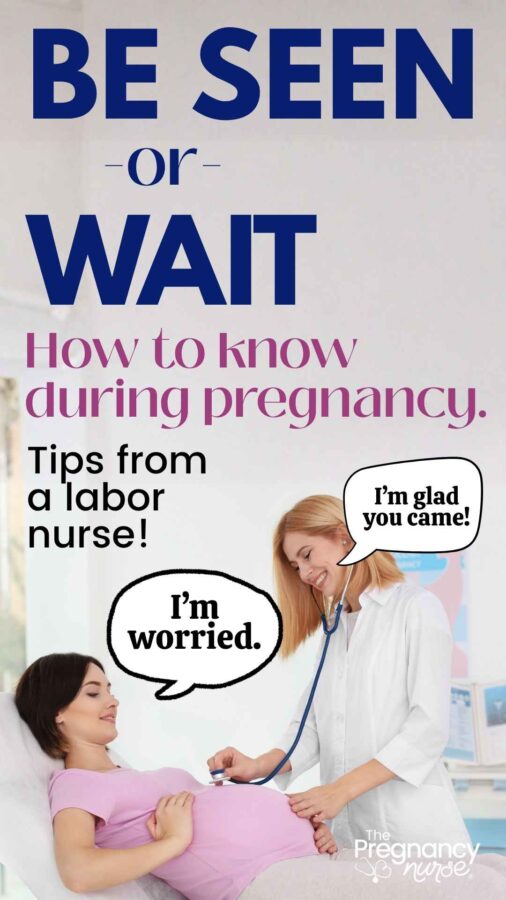
Pregnancy is FULL of symptoms that make you think — is that bad? Today I want to give you some very basic guidelines of when to call your provider (or, more importantly when to head into labor and delivery) and when to wait.
This (or any article on The Pregnancy Nurse) should be taken as medical advice, this purely educational. Please talk with your provider about your specific needs and circumstances.
I always try to look to nature when I’m thinking about our bodies (some of you might think that’s weird for The Pregnancy Nurse® – but we’re natural people too!). And, one of my favorite places is to be is at the beach. I love to watch (and listen to) waves — and it’s so interesting to me that the tides go in and out like clockwork.
But, how do we know when it’s a problem? When the ocean goes all the way out — aka, a tsunami is coming. It’s something very different than what usually happens.
So, there are times baby is quiet and times when they’re a crazy dancer.
There’s times when you’re tired, and then times when you feel energetic.
There’s times you get a contraction or two, and times when you don’t.
All of that can be really normal — the “waves of pregnancy.”
What’s a problem is when it’s something outside of the norm…. Like suddenly outside the norm? The waves haven’t been creeping up for a while and suddenly you get wet. The waves have been miles and miles away and suddenly you see water coming…. (and we all know that if the tide is WAY out — it’s time to get to higher ground!).
Now, some of these times you go directly to the hospital. Sometimes you call your provider. Sometimes you wait til’ your next prenatal visit. There’s levels…. And when in doubt, call them! That’s what they’re there for and prenatal visits are only if things feel normal. If things change, and you’re worried — call them!
New pains and changes in pregnancy should be mentioned at your regular prenatal visits. I’d keep a list of questions, and changes in your body in your notes out. It will help remind you during that quick visit! I’m talking small things — tiny pains that crop up and start to expand…
Anything that can be brought up, or handled at a regular appointment will save you so much time and energy — so, being sure to use them to their fullest will be a huge benefit to you and your pregnancy!
Rule of Thumb
My main rule of thumb is that if you’re noticing a BIG difference from when you’ve normally been feeling that’s worth a call.
If you’ve had something going on for weeks, and it just keeps going on, might be worth a call but it tends to not be as urgent.
I also have a post on pregnancy pains that are actually warning signs that you might find helpful!
Postpartum Rule of Thumb
Really quick — postpartum isn’t a time to turn-off your radar.
My rule of thumb postpartum is that it should, over time, be getting better. If something starts to feel dramatically worse be it — bleeding, healing, anxiety, sadness or pain levels — call your provider.
I actually have a whole free postpartum class where I walk you through some warning signs during postpartum (honestly, also helpful to watch for during pregnancy).

Remember, there will always be ebbs and flows to our pregnancy, and our healing. It’s those big changes that should remind us to do something.
Let me give you some examples….
Headaches
Headaches were part of each of my pregnancies. Lack of sleep, dehydration, changes in posture, hormones, and probably electrolytes are in flux during pregnancy. If that’s you too, tell me in the comments!
I just had a dull headache most days. It was just there. Like a buddy (not one I liked though).
I found this to be true with a lot of my patients too!
If I’d woken up and suddenly the headache had changed — was significantly worse. I should call.
Now, if you suddenly get the “worst headache of your life” — go directly into labor and delivery. It could be preeclampisa or blood pressure issues that we should take seriously!
Of course, I think every adult should have a blood pressure monitor. They’re not expensive. I think I thought they were pricey — but you can often find them for under $20 (affiliate link). But seriously get one if you don’t have one!
So, if that headache changes dramatically, call your provider, if it’s the worst one of your life. Just head into L&D.
At your next appointment: Ask your provider how quickly you should expect a call back from them. Some offices it’s not til’ the end of the day (and that may not be adequate — so, I’d ask how to ask them a more urgent question). That way you have realistic expectations. I’d also ask how you can get hold of someone when the office is closed. Most have someone on call for urgent questions (just only use those for urgent matters, not regular questions).
Want to know more provider tips — check out these posts:
- Tips To Saying No To Your Provider
- 6 Things Your Provider Does at Prenatal Appointments that Are Important
- The Best Providers for Your Baby’s Arrival
- 5 Things Your Provider Should Get Consent For During Labor
- Picking Your Pregnancy Healthcare Provider
Fetal Movement
As you head into your third trimester (about 27 weeks) you’ll be able to notice a “normal” pattern of movement with your baby.
Why 27 weeks? Prior to that the placenta, baby’s position, and just general size can make baby feel more “muffled” at times. So, size matters. You can still pay attention to baby’s movement prior to that, but it’s just hard to get a handle when things are “decreased” because it’s OFTEN due to the placenta or baby’s position.
One of the best things you can do is do kick counts. I’m a huge fan of them because studies show it can save up to 30% of stillbirths. No clue how to do them? — grab my cheat sheet!

But, beyond that you’re just noticing what’s normal for your kid?
And, as a note — those first few weeks after 27 weeks is really just deciding what’s “normal.”
Your baby takes an hour or two naps, and then has a dance session — that’s their normal.
Your baby never sleeps and dances all day long. That’s their normal.
Your baby is quiet — you don’t feel much at all — that’s their normal.
The crazy thing — all of these can be normal. Because normal is what’s normal for your baby.
Remember how you assess fetal movement can be due to baby’s position, your body (sometimes larger gals have a harder time feeling as much) and even the placenta! Just because you have a “quiet” baby doesn’t mean they’ll be quiet on the outside! Might just be what you’re feeling from them.
Things that are way out of your baby’s normal movement pattern (after 27 weeks) should send you into labor and delivery. I’d skip your provider on this one, just head right in. And yes, that does mean DECREASED movement, but also INCREASED movement as well!
Things feel just a little off, might be worth a call to your provider. But, big changes can mean bigger problems that are best managed at the hospital.
Want to know more about fetal movement? — check out these posts:
- Normal Daily Fetal Movement – Kick Counts
- 30 weeks Pregnant and Baby’s Movements Have Slowed Down
- Increased Baby Movements Before Labor
- Kick Counts Made Simple: FAQs, Expert Tips, and Why It Can Save Babies’ Lives
- When Should You Start Kick Counts?
Swelling
Now, we used to take swelling as a symptom of preeclampsia, but anymore we know that swelling can be a very normal part of pregnancy. Especially for ladies who are on their feet a lot (👊 solidarity with all the pregnant nurses out there!).
However, if you wake up and you suddenly have swelling — be it in your hands or your legs, or your face (I see a LOT of people who suddenly have swollen noses — often mentioned by a partner). I’d call your provider. Just ask to be seen.
Of course, I’d also take my blood pressure to check that at home. (BECAUSE EVERYONE SHOULD HAVE A BLOOD PRESSURE CUFF). Get one asap if you don’t have one (yes, that’s a partner link but I REALLY think that — it’s just how I can link out).
Again — this isn’t a swollen face for weeks, or swelling after a day at work. All of that has been around, or is normal for you. It’s that brand new symptom that can be disconcerting!
Oh, and if you’re under 20 weeks you should 100% be having the conversation with your provider if aspirin is right for you (that’s another soapbox of mine!).
Bleeding
Now, any bleeding early on in pregnancy should be seen by your provider.
But, some of you just bleed now and then (it’s important to get an idea from your provider what’s OK and what should send you to them or the hospital). And it might be OK (again, be SURE to make sure this is true for you and your pregnancy with your provider).
But, you suddenly have blood in your underwear — you’re seen asap, right? It’s a new symptom. And, if it’s a lot you go straight into L&D.
Of course, to make it super tricky some bleeding can be normal after about 36 weeks — but when has pregnancy ever been cut and dry?
I just want you to think about those rules of thumb.
You know your pregnancy “normal” — for me it was being tired, having a headache, pain between my legs, and mostly enjoying a baby who rarely stopped movement.
But, if I woke up one day and one of those changed a lot — it’s time to be seen.
Two things to remember:
- Your prenatal appointments are for routine care. When you find something outside of that routine, your provider should be seeing you for that (this is true for both pregnancy and postpartum), or at least a phone conversation with their staff.
- Big changes for what’s normal for you — that’s when you need to be seen.
Plus, those warning pains. 🙂 And anything your provider mentions…
Because, for some people even one contraction, or a tiny bit of blood should send them directly into labor and delivery — even though for a lot of you many of those things are fine!
And if you EVER have a concern for you or baby’s safety labor and delivery is open every day, all day all year (even Christmas). I can promise you that we want to see you, we want to see that you and baby are safe than you having a problem that we’re too late to help with!
Understanding how the hospital works and what to expect when you get there is such a smart thing to do. I recommend this. Plus, it’s made to help your partner get prepared too! It’s how smart couples feel confident going into birth.
So, what kinds of questions do you have? I can’t give a cut and dry answer for all of you, because everyone’s so different — but I’d love to try to answer questions in the comments if you have them. Just tell me below!
- About the Author
- Latest Posts

A nurse since 1997, she has worked in various fields including pediatrics, geriatrics & hospice. She has 20 years of labor and delivery experience in the San Jose, CA and Phoenix, AZ areas.
As an evidence-based prenatal educator Hilary has delivered thousands of babies and has educated hundreds of thousands of parents from a diverse patient population to help them have a confident birth.
 37 Weeks: A Checklist for The Last Weeks