


You go in for a prenatal check, only to find your blood pressure is up. What happens next (or what SHOULD happen next if nothing happens for you). Today I’m going to share what you should be watching for! I’m so glad you’re here getting prepared!
Note for anyone under 20 weeks: PLEASE make sure you’re having a talk with your provider about aspirin in pregnancy. It’s the right choice for a lot or pregnant patients (but not all of you). So make sure you’re chatting through it with them.
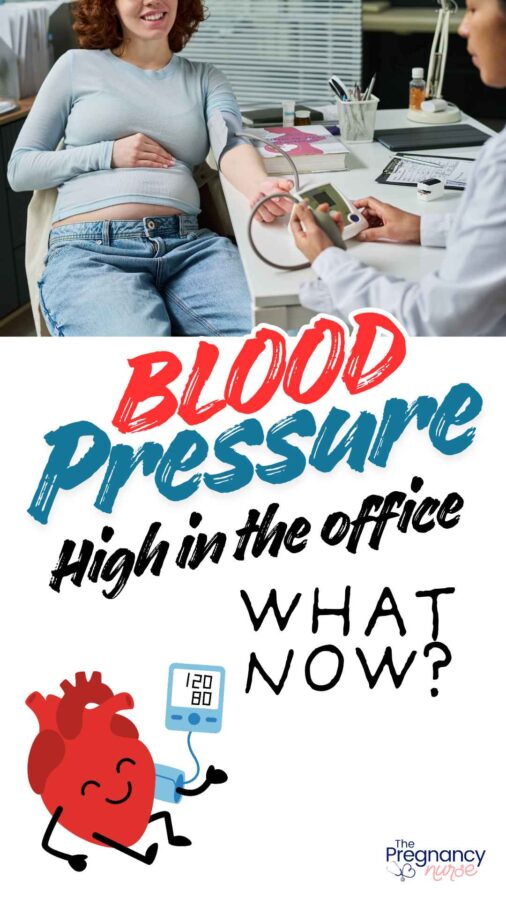
Blood Pressure Check at Prenatal Appointments
Usually the events should be:
If that initial blood pressure cuff is high, the provider’s assistant notes it and may take it again in the room with an actual blood pressure cuff (or a different one).
Some things to note about blood pressure readings:
- Size of cuff matters. Have a larger arm — they need to use a larger cuff. You can always mention “that cuff looks a little small, I’m happy to wait while you find a larger one”
- Timing matters — I was always feeling harried and had my other kid (and a backpack of toys) with me, so that first reading was often high. Once I got into the room, we all settled in (with said toys) the reading would come down.
This is where I encourage you to have your own cuff at home. Every adult should have one. That way you can check it at home when things are chill or if you ever have a headache, etc. You can get one super cheap on amazon (affiliate link). They’re a LOT better than they used to be and are a handy tool to have at home.
What Is a High Blood Pressure?
The “average” reading is 120/80 — however, you will likely have had your blood pressure checked several times at the office, so — sometimes high is just higher than your usual.
AS a note, 120/80 was actually normal for men 🙄 — so women tend to be a bit lower.
However, as a standard 140/90 is considered high. It’s considered severely high at 160/110 (honestly, if either number — the upper or lower — approaches that we get concerned — and that’s when we might consider medications to lower it).
What Happens Next?
If it’s high, your provider should mention it in the room. Time to at least discuss it.
For me, I always asked them to re-take it in the room. I also sometimes wonder if the “sound” of the electronic blood pressure cuff was enough to make mine rise (I’ve heard it a LOT in my time). When they used the manual one in the room (the one they pump up and watch the needle fall) once my doctor was in, it was always better.
One high reading isn’t a huge deal (especially when you’re already out of breath and stressed – not the best time to take it anyway — blood pressure should be taken while one is at rest).
If it continues to be high the path will vary a bit…
Are you prior to 20 weeks of pregnancy (sometimes even just prior to your third trimester) — in this case, it’s not diagnosed as preeclampsia, but instead as gestational hypertension. Your provider should consider some blood pressure meds to help maintain it at a healthy level.
Did you leave a pee sample? If so, they’ll check to see if you’re spilling protein in your urine. This can be an indicator of preeclampsia.
Remember: They really don’t diagnose preeclampsia prior to 20 weeks of pregnancy — so if you’re early on, that would lean more towards hypertension than that.
It would be considered gestational hypertension — or, high blood pressure caused by pregnancy. However, if you haven’t had your blood pressure checked much before pregnancy it may just be hypertension (the medical word for high blood pressure). Either way, it’s something you’re going to watch for postpartum as well (GET A BLOOD PRESSURE CUFF). Even if it’s just high in pregnancy, you’re at a higher chance of it being high as you get older, so lifestyle changes would be smart.
Any other symptoms? After that, they may go through other symptoms of preeclampsia. Just because you are past 20 weeks doesn’t automatically mean that it’s preeclampsia, just means we need to dig a little deeper.
Signs/Symptoms of preeclampsia include:
- Blurry vision
- Headaches
- Right sided rib pain
- They may also look for swelling (although not an “official” sign).
Likely, they will have you go get some preeclampsia labs, although if you’re having other symptoms they may just send you into labor and delivery to get checked out (and have those lab drawn). While there, they’ll take a series of blood pressures as you get into the room and then as you settle into the bed.
If your blood pressure remains high during this they may consider giving you medication to help it to come down. We don’t want blood pressures sky high, it’s not good for your heart. It’s a discussion to have with your provider.
The labs are pretty definitive and will help your team decide if it’s preeclampsia, or gestational hyptertension. The labs include:
- A urine test where they look for proteins (and sometimes also the protein/creatinine ratio)
- Liver enzymes (they can rise with preeclampsia) — called ALT and AST
- Platelets (these can fall with preeclampsia) – ususally taken with a complete blood count (or CBC)
- Uric Acid
These labs are often called a PIH panel (PIH is the word we used to use for preeclampsia).
It’s also called HELLP syndrome that stands for
- Hemolysis — destruction of red blood cells
- Elevated Liver enzymes
- Lowered Platelets
That always helps remind me what we’re looking for.
If the labs come back pretty normal, that would be gestational hypertension. Depending on how far along you are, they may consider medications to take at home to lower your blood pressure, or just watch it.
If they come back high it’s a time to consider if you and baby are better off with it inside, or if you should be induced.
This is a grey area — and it really depends on your symptoms, and what the labs are showing. I actually talked about this on my podcast with one of my favorite OBGYN’s — might help you out to realize you can still make a choice even if the labs are a bit high
It’s important to know what you want, possibly also what your cervix is to make the best choice for you in the moment. If you haven’t made a birth plan — now is a good time to start. I have a freebie series you can grab!

No matter what choice you make today, you need to know that there will be more choices in the days ahead. Getting prepared asap is smart.
Want to know more about prenatal care — check out these posts:
- When to Actually Call Your Provider (or go in) vs. When to Wait
- Pregnancy, Tylenol® & Autism: What Expecting Moms Need to Know
- Signs You’re Ready to Be Induced
- How To Build Confidence For Your Birth Experience
- 4 Things You Can Do to Prepare Your Cervix for Labor
Why no blood pressure meds?
It’s a valid question, and something I’ve wondered a lot.
I mean, if the blood pressure is sky high we will give you something in the hospital (sometimes in an IV).
However, if it’s just in a high range they don’t want to “mask” preeclampsia by giving you something.
Also, the baby and the placenta have likely gotten used to your blood pressure being elevated, and if we bring it down too much they may not get the blood flow they’re used to.
It’s tricky and a balance for sure. But, if you have any questions please do talk with your provider about if medication is right for you, and why so or why not?
Will I Have to Be Induced?
The reality is that most often the blood pressure doesn’t just “come down” (unless you’re in a period of high stress, or like me — just hauled a 30 pound backpack full of matchbox cars to the scale/blood pressure cuff).
During pregnancy, we often see a small rise in blood pressure early on (as your body is building extra blood volume to sustain the pregnancy) and then it lowers mid pregnancy, and then again starts to rise later on in pregnancy. For the most part these changes aren’t big — but you might notice them during the span of your pregnancy.
If you’re aren’t getting induced that day (if you’re past 36’ish weeks it is something they may offer or recommend) they will continue to watch blood pressures, as well as taking preeclampsia labs to see what’s going on there. You’ll also want to monitor for headaches (and your blood pressure) at home.
Ask your provider what are things that would make you head into their office or go straight into labor and delivery.
Want to know more about induction? — check out these posts:
- Advanced Maternal Age – Do you have to be induced at 39 weeks?
- Pumping To Induce Labor? Will it work?
- 5 Things NOT to do Before Your Induction
- Pitocin to Induce Labor
- 5 Reasons to NOT Get Induced
Pro Tip: If this is an issue for you, an induction is pretty likely. Make SURE that you’re taking a birth class that includes induction. I recommend this one.

Is my Baby OK?
This is a big question. Preeclampsia can actually lower the amount of blood that is getting to the baby. Think of a hose that’s just flowing and pouring into a watering can. It’s easy to get it into the hole because it’s just got a nice, even flow. However, if you put your thumb over the edge of it and increase the flow it is harder to get into the bucket because it’s just busting out of the hose.
Same idea with the baby — their blood flow can be compromised.
First of all, you’re going to want to make sure that you’re monitoring for fetal movement throughout the day — and also doing your kick counts. No clue what those are — I have a cheat sheet!

They may order NST’s or other 3rd trimester testing as well to watch on baby (and you). Btw, this testing is so important to understand. I talk about it in chapter two in here.
With both gestational hypertension and preeclampsia, the big question is when it’s best for baby and you that baby be born. The big fix for both hypertension and preeclampsia, is no longer being pregnant… so doing that at the right time is important.
As a note: These can still both show-up postpartum. So, again — keep watching for any headaches and high blood pressure in those six’ish weeks after baby is born (although there have been cases that showed-up even close to a year after birth — so be vigilant).
While neither of these are things that you should mess around with, there is a spectrum of where you fall on it. Things your provider will consider:
- What is your blood pressure reading? Is it just a hair over 140/90 sometimes, or is it consistently much higher or approaching the 160/110 area (honestly, if you’re that high that shows baby needs to come out).
- What are your labs, and how are they “trending” — if you get them a week later and they’re similar maybe things aren’t progressing too fast, or maybe you get them a week later and everything’s way up — that can be an indicator.
- How baby looks on the monitor (most often checked with an NST, and sometimes a BPP as well — and if you want to know more about those check out this).
Want to know more about pregnancy complications? — check out these posts:
- What to Do If Your Water Breaks
- From Sharp Stabs to Relief: Navigating Ligament Pain in Pregnancy
- When Should You Start Kick Counts?
- Navigating Pregnancy After Miscarriage
- 5 Warning Signs of a Difficult Delivery
Is High Blood Pressure Bad for Mom?
Yes, it can be.
Some high blood pressure can be OK, and your vessels are meant to expand to manage the increase blood volume in pregnancy.
BUT sometimes it can overwhelm the heart and cause long-term issues, most often cardiomyopathy (where the heart enlarges to mange the blood pressure) — which can cause long-term issues. We are seeing this more and more, unfortunately.
SO, watching it carefully is important.
Final Thoughts
Every situation is unique. What you and your body are doing is very different than anyone else’s pregnancy. It’s important you both take your preferences, your history and your provider’s advice and make a good choice for you moving forward.
But, also remember that circumstances can change, and your choices can change.
Both of these conditions are rising in pregnancy. It’s not something we saw a lot of when I started in 2001, but we see it a lot now, and is often the reason people end-up getting induced earlier than they hoped for.
It’s important to plan for all scenarios, and get prepared!
Did this happen to you? Tell us down in the comments what happened when your blood pressure was high in the office!
- About the Author
- Latest Posts

A nurse since 1997, she has worked in various fields including pediatrics, geriatrics & hospice. She has 20 years of labor and delivery experience in the San Jose, CA and Phoenix, AZ areas.
As an evidence-based prenatal educator Hilary has delivered thousands of babies and has educated hundreds of thousands of parents from a diverse patient population to help them have a confident birth.
 When to Actually Call Your Provider (or go in) vs. When to Wait